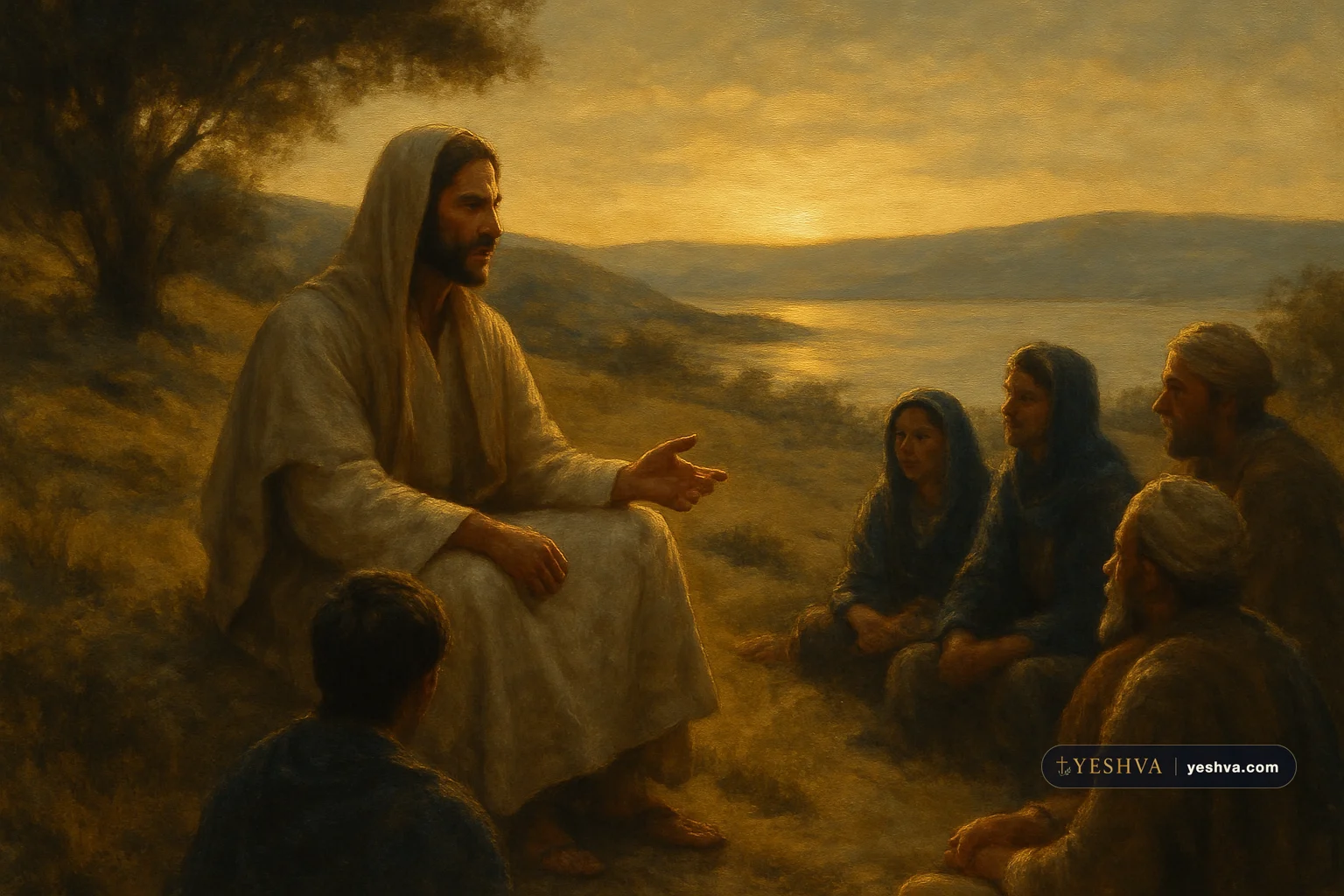
On the night before he died, in an olive grove outside Jerusalem, Jesus prayed with his face to the ground and called God Abba (Mark 14:36). Mark keeps the Aramaic word, the ordinary family word a child used for a father. It was not baby talk, as is sometimes said, but it was startlingly close, and Paul later tells ordinary believers that the Spirit teaches them to pray the same way (Romans 8:15).
That one word sums up most of what Jesus taught about prayer. He did not hand out a technique. He described a relationship, and then he showed it by the way he lived.
Jesus prayed himself
The Gospels show Jesus praying again and again. One early scene has him rising well before daylight to go to a quiet place and pray, after an evening when the whole town had crowded his door (Mark 1:32). Before choosing his closest twelve followers, he spent a night in prayer (Luke 6:12). On his last evening he prayed in Gethsemane, honestly asking whether the suffering ahead could be taken from him, and then trusting his Father with the answer (Mark 14:32). Luke adds that his disciples first asked him to teach them to pray after watching him do it (Luke 11:1).
The pattern is worth noticing. Prayer for Jesus was not a last resort or a ritual for special days. It was the ordinary place where he drew close to God, especially when life was heavy.
Not a performance
Jesus was direct about showy religion. He warned against praying on street corners in order to be admired, and told his hearers to go into an inner room and shut the door. He also warned against piling up words as if God had to be worn down into listening (Matthew 6:5). His reason is that God already knows what we need before we ask.
That can sound odd. If God knows, why pray? Christians have answered that prayer is not about informing God. It is about trusting him, being honest with him, and letting the conversation change us. A child tells a parent what is on their mind, not because the parent is unaware, but because that is what closeness looks like.
The Lord's Prayer
One day a disciple asked him to teach them to pray, and Jesus gave them a short prayer (Luke 11:1). Matthew records a slightly fuller version inside the Sermon on the Mount (Matthew 6:9). Christians call it the Lord's Prayer, or in Spanish the Padrenuestro. Its shape is easy to remember:
- It starts with God. You address him as Father, and you care first about his name and his purposes.
- It asks for daily needs. Bread for today, not a lifetime of supplies.
- It asks for forgiveness and offers it. Being forgiven and forgiving others are tied together.
- It asks for protection. From the time of testing and from evil, or from the evil one; the Greek can be read either way.
The familiar ending about the kingdom, the power and the glory is not in the oldest manuscripts of Matthew. It was added very early in Christian worship, and a shorter form already appears in the Didache, a church manual from around AD 100. That is why some churches say it and some do not, and why Catholics add it after a short prayer in the Mass rather than straight on. Many Christians pray these words exactly as written. Others use them as an outline for their own words. Both are welcome.
Keep asking
Jesus told two stories to encourage persistence. In one, a man knocks at his friend's door at midnight to borrow bread for an unexpected guest, and the friend finally gets up, not out of friendship but because the caller has no shame about asking (Luke 11:5). In another, which Luke says was told so that people would keep praying and not lose heart, a widow keeps returning to an unjust judge until he acts (Luke 18:1). The point is not that God is like a grumpy neighbor or a corrupt judge. It is the opposite: if even they respond, how much more will a good Father. Jesus says exactly that, comparing God to a parent who gives good gifts to his children (Matthew 7:7).
This does not mean every request is granted as asked. Christians have wrestled with unanswered prayer for two thousand years. Jesus himself asked that the cup of suffering might pass from him, and then put his Father's will ahead of his own (Mark 14:32). Most Christians would say prayer is not a way of getting what we want, but of coming to want what is good, while trusting that we are heard.
Humble, not impressive
Jesus told a story of two men who went to pray at the temple. One was religious and proud and thanked God that he was better than others. The other, a tax collector, could barely lift his eyes and simply asked for mercy. Jesus said the second man went home right with God (Luke 18:9). If you are afraid you will pray badly, this story is for you. A short, honest sentence is not a lesser prayer.
Forgiveness and praying together
Jesus connected prayer with how we treat people. He said that when you stand praying and remember that you hold something against someone, you should let it go (Mark 11:25-26). He also promised his presence to even the smallest gathering of his followers who meet and agree in his name (Matthew 18:19). The setting is a church settling a dispute, but Christians have long taken it as a reason to pray with others, not only alone.
Praying in Jesus' name
In John's Gospel, Jesus tells his followers to ask in his name (John 14:13). Christians do not treat this as a magic phrase added at the end. It means praying as his people, in line with his character, trusting the access he opened to the Father. It is why many prayers end with the name of Jesus and the Hebrew word amen, meaning roughly "so be it" or "truly."
How to begin
There is no required posture or language. You can sit, kneel, walk or lie down. You can speak aloud or think silently. A simple way to start is to say what you are thankful for, say what is weighing on you, and ask for help with one thing today. If words will not come, you can begin with the Lord's Prayer and let it carry you. Nobody is grading it.
If you would like a guided week, the reading plan linked below walks through prayer as Jesus taught it. And if you have never prayed before, praying honestly to whoever might be listening, saying you would like to know him, is a real start. Jesus promised that those who seek will find (Matthew 7:7).
If you want one step for today: tonight, before you sleep, pray the Lord's Prayer slowly, one line at a time, stopping after each line to say one thing of your own.