Ask most people where Jesus was born and they will say Bethlehem, and they will probably picture a wooden stable, a star, three kings and an innkeeper shaking his head. Bethlehem is right. Several of the other details come from later tradition rather than from the Gospels, and the real picture is, if anything, more human.
Bethlehem in Judea
Two of the four Gospels tell the story of Jesus’ birth, and they agree on the place: Bethlehem (Matthew 2:1, Luke 2:4). Bethlehem was a modest village in Judea, about six miles (roughly ten kilometers) south of Jerusalem. It was known as the hometown of King David, which gave the place a quiet importance in Jewish memory.
Long before Jesus, the prophet Micah pointed to Bethlehem as the place a future ruler of Israel would come from (Micah 5:2). Matthew connects the two, saying that Jesus’ birth there fits that ancient hope (Matthew 2:3).
Why were Mary and Joseph there?
Mary and Joseph lived in Nazareth, in the northern region of Galilee, about 90 miles (some 150 kilometers) from Bethlehem, several days on foot. Luke explains that they traveled south because the Roman emperor Augustus had ordered a census, and Joseph, who descended from David, had to register in his ancestral town (Luke 2:1).
Historians discuss this passage. Luke names Quirinius, a Roman governor of Syria, and the Jewish historian Josephus dates a census under Quirinius to AD 6, some years after Jesus was probably born. Scholars have proposed several answers, such as an earlier registration under Quirinius, or a looser use of the word in Luke’s account. It remains a point of scholarly conversation, and many Christians read the passage with confidence while accepting that some details are hard to line up with other records.
The manger, the shepherds and the “inn”
Luke says Mary wrapped her newborn and laid him in a manger, a feeding trough, because there was no room for them in the guest space (Luke 2:6). The word often translated as “inn” can also mean a guest room in a family home. Many scholars think Joseph’s relatives housed them, with the animals sharing the lower level of a simple house, and the manger sat close by. That is a bit different from the innkeeper turning them away, a scene the Gospel never actually describes.
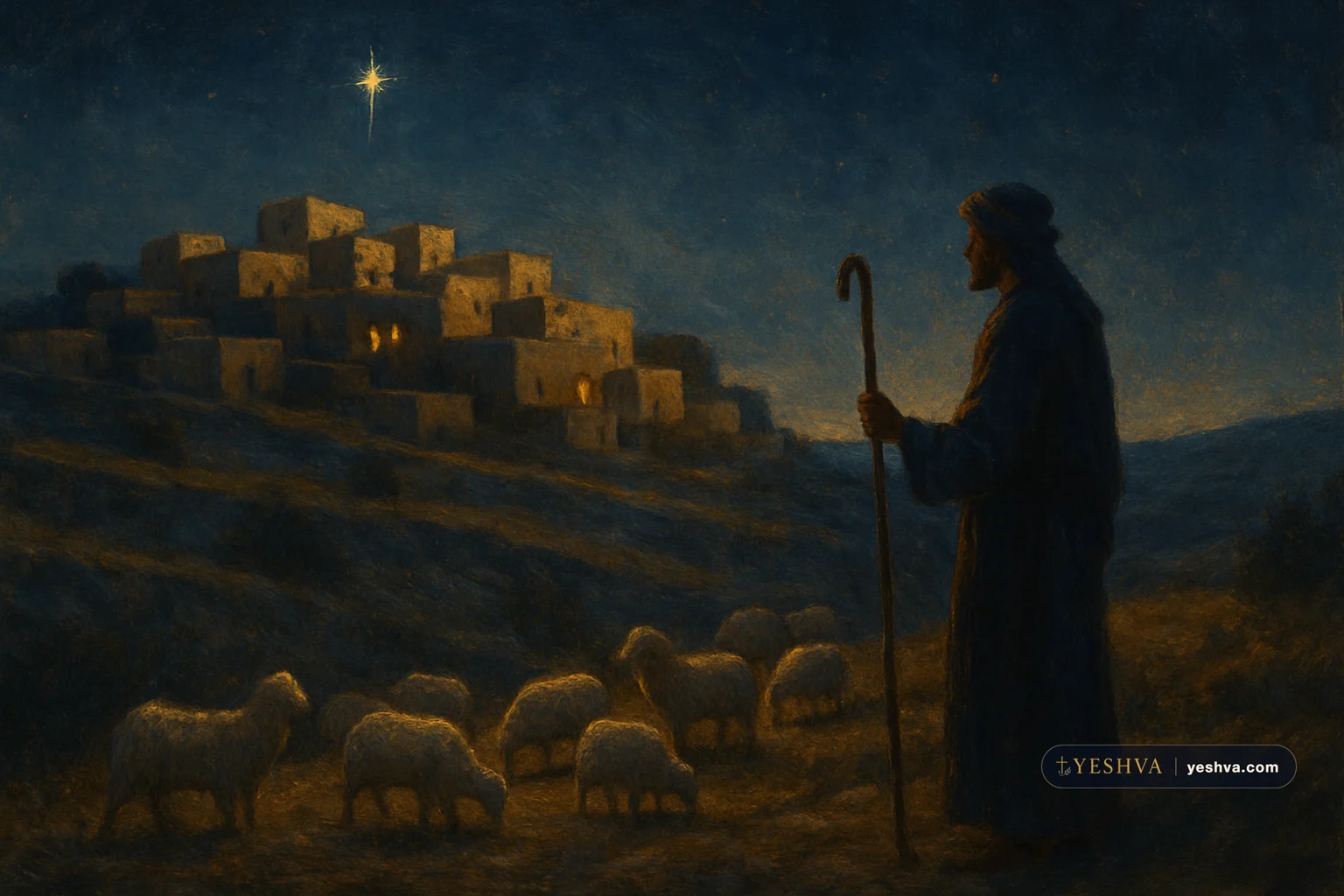
The first people to hear the news were shepherds working in the fields nearby. It is a striking detail. Shepherds were ordinary, hardworking people, not the powerful ones, and Luke says they hurried into town to see the child for themselves (Luke 2:8).
The visitors from the East
Matthew adds a different scene. Wise men, often called magi, came from the East asking about a newborn king of the Jews, guided by a star (Matthew 2:1). Matthew does not say there were three of them, nor that they were kings. The number comes from the three gifts, and the tradition of names and crowns developed much later.
They probably did not arrive on the night of the birth. Matthew describes them finding the child in a house, and King Herod’s later order shows he believed the child could be up to two years old (Matthew 2:11, Matthew 2:16). This is why many nativity scenes combine two separate moments into one.
Escape and return
Herod the Great was a powerful and suspicious ruler, and Matthew says he tried to have the child killed. Joseph was warned, and the family fled to Egypt until Herod died (Matthew 2:13, Matthew 2:16). Afterward they settled in Nazareth in Galilee (Matthew 2:19, Luke 2:39).
Nazareth was a small village, and people did not expect much from it. When Nathanael first heard about Jesus, he asked, half joking, if anything good could come from there (John 1:45). That is why Jesus was known as “the Nazarene,” and why even though he was born in Bethlehem, he is called Jesus of Nazareth.
When was he born?
The Bible does not give a date. Most historians date King Herod's death to 4 BC (a minority argue for a year or two later), so Jesus was most likely born a few years before that, somewhere between 6 and 4 BC. It seems odd that he would be born “before Christ,” but it comes from a calculation in the sixth century by a monk named Dionysius Exiguus, who was off by a few years when he set up the calendar we now use.
December 25 is not mentioned anywhere in the Gospels either. By the fourth century, Christians in Rome were celebrating the birth of Jesus on that date, and Eastern churches kept January 6 for related feasts. How that date was chosen is debated. Some think it was set against a winter festival in Rome; others point to an early Christian calculation that counted nine months from a traditional date for the conception in late March. Either way, most Christians agree the exact day is not what matters. Luke mentions shepherds with their flocks outdoors at night, and some readers think this points to a milder season than midwinter, though others note that it is not conclusive.
Why it matters where he was born
The birthplace tells a story. The one Christians call the Son of God did not arrive in a palace in Jerusalem or Rome. He was born to an ordinary young couple in a small town, under an empire that did not care about them. Luke wants the reader to notice that Caesar’s census is the backdrop, while the real event is happening quietly in a poor household (Luke 2:1).
Many Christians find hope in that. God’s biggest moments do not always happen in the biggest places, and no one is too small or too far away to matter.
Visiting today
Bethlehem is today in the West Bank, and pilgrims from around the world still visit the Church of the Nativity, one of the oldest continuously used churches in the world. The emperor Constantine had the first church built over a cave there, dedicated in AD 339, and the present building goes back largely to Emperor Justinian's rebuilding in the sixth century. Historians take the location seriously because Christians were pointing to that cave long before any church stood on it: around AD 150, Justin Martyr already wrote that Jesus was born in a cave near the village. Simple homes in the area were often built against caves used for animals, which fits Luke's manger. Still, no one can prove the exact spot.
If you want to read the birth stories yourself, Luke 2 and Matthew 1 and 2 are short and can be read in one sitting. The next page looks at what Jesus may have looked like.