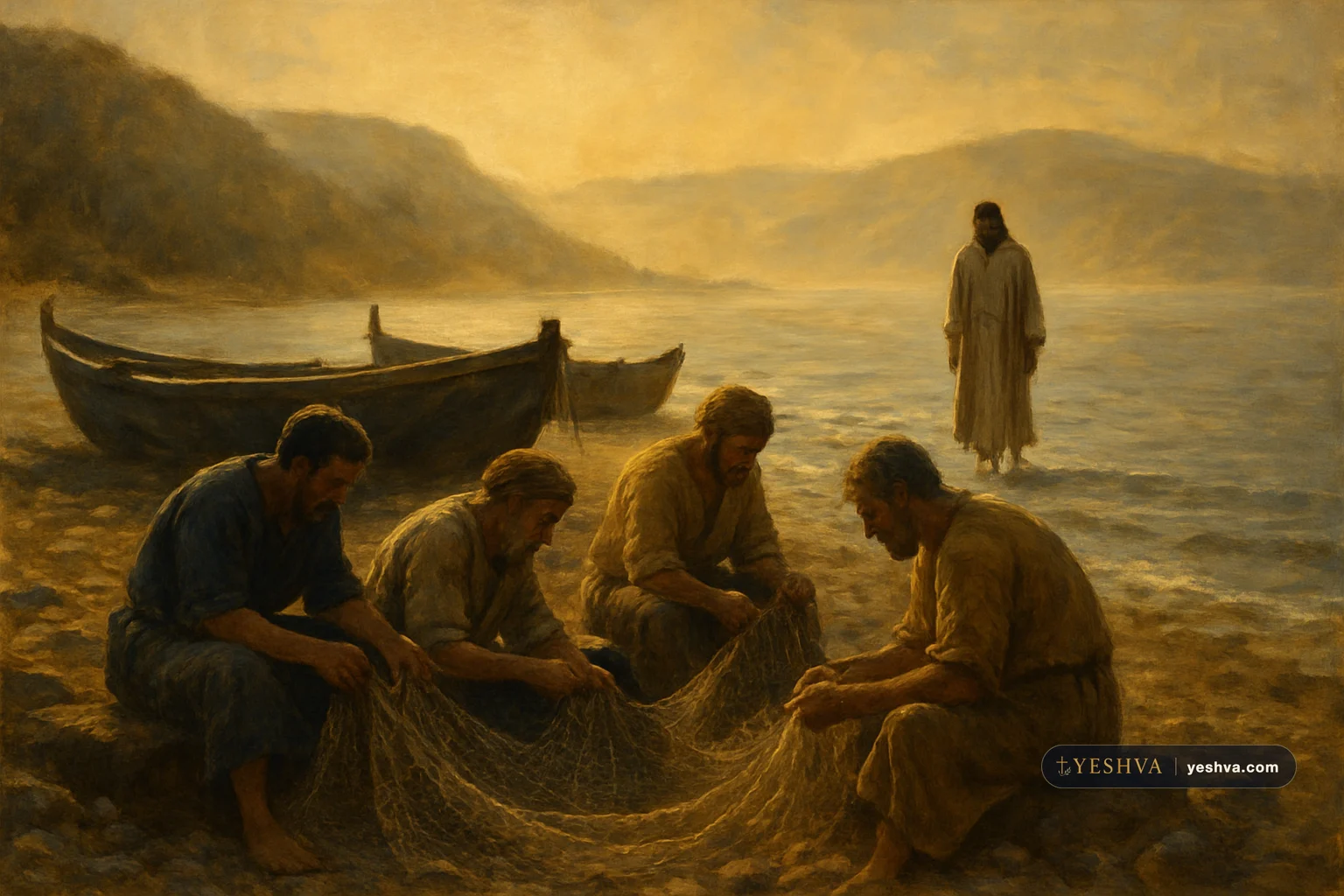
Almost everyone can picture Jesus: shoulder-length hair, a beard, a calm face, often light brown hair and light eyes. But that image is sixteen centuries of art talking. The people who knew him left us almost nothing to go on, so this page keeps two lists apart: what we can reasonably say, and what we simply cannot.
What the Gospels do not say
The four Gospels tell us a great deal about what Jesus did and taught, but not one of them describes his height, his face, his hair or the color of his eyes. That silence is striking, since ancient writers sometimes did describe important people. Most readers conclude that the writers cared far more about who he was than what he looked like.
There is one clue often quoted from the prophet Isaiah, who wrote about a servant with no striking beauty that would draw people to him (Isaiah 53:2). Christians read that passage as pointing to Jesus, so some have taken it to mean that he was plain and unremarkable. Others say the poem is about his suffering, not his features. Either way, it is not a description of a face.
There are hints in the stories, though. When Jesus walked into a crowd, no one seems to have stopped and stared. In his hometown people said they knew him as the carpenter and were surprised by his teaching (Mark 6:1). On the night of his arrest, his enemies needed a follower to point him out (Matthew 26:47). Even after the resurrection, close friends did not recognize him right away (Luke 24:13, John 20:14). All this fits a man who looked like his neighbors.
What history suggests
Jesus was a Jew born in Judea and raised in Galilee around two thousand years ago. Skeletal remains from Jewish burials in that area and period, and art from that world, point to people with brown skin, dark hair and dark eyes, and probably a fairly compact build by modern standards. In 2001 the British medical artist Richard Neave and his team built a reconstruction for a BBC documentary from skulls of Jewish men of that period. It was never meant to be Jesus, only an example of what a man of that time and place could have looked like: a broad face, dark eyes and short, curly dark hair.
He was also a working man. Mark calls him a tekton, a builder or carpenter, and Matthew calls him a carpenter’s son (Mark 6:3, Matthew 13:55). Either way, it meant years of physical work with wood and stone. He walked long distances on foot across the hills of Galilee and Judea, so it is fair to imagine him as lean and weathered rather than delicate.
Clothing, beard and hair
Jewish men of the time commonly wore beards, and Jesus was almost certainly bearded. He would have worn a simple tunic, a cloak, and sandals. The Gospels mention the edge of his cloak, most likely its tassels, which observant Jewish men wore as a reminder of God’s commandments (Matthew 9:20, Numbers 15:38). At the crucifixion the soldiers divided his clothes among themselves and threw dice for his tunic, which was woven in one piece and would have been ruined by tearing (John 19:23).
Long hair is less certain. Portraits and coins from the period suggest that men in the Roman world, Jews included, usually kept their hair fairly short, and Paul could assume his readers found long hair odd on a man (1 Corinthians 11:14). The flowing hair of most paintings owes more to later art than to first-century Galilee; some scholars think it was borrowed from images of Greek gods such as Zeus. Nobody knows for sure, and little depends on it.
Where the familiar image came from
The earliest pictures of Jesus are not portraits. In the catacombs of Rome, Christians of the third century painted him as a young, beardless shepherd carrying a lamb, borrowing a familiar image from Roman art. Beginning in the fourth and fifth centuries, artists in the Roman and Byzantine world started showing him as a majestic bearded ruler, echoing depictions of emperors. Over the centuries, European painters gave him the features of the people they knew, and that is how the fair-skinned Jesus came to fill churches and Sunday school walls.
Believers in other places have done the same. African, Asian, Latin American and Middle Eastern Christians have painted Jesus with the faces of their own communities, and many say this is a beautiful expression of the claim that he came for everyone. The concern is when one image becomes the only one, and people forget the actual man was a Middle-Eastern Jew.
Is it wrong to make images of Jesus?
Christians differ here. The commandment about not making carved images of God (Exodus 20:4) led some traditions, especially within parts of Protestantism, to avoid religious images. Others, including the Orthodox and Catholic churches, argue that because God became visible in Jesus, drawing him is allowed and even honors the incarnation. Many Protestants are comfortable with images used to teach and remember, but not to worship. The church debated this seriously in the eighth and ninth centuries, and the question is still discussed with respect on all sides.
What about the Shroud and other relics?
Objects like the Shroud of Turin are believed by some to show the face of Jesus. Radiocarbon testing in 1988 by three independent laboratories dated the cloth to between about 1260 and 1390, though some researchers continue to question the samples and the results. The Christian faith does not depend on it either way, and many believers are cautious about relics whose origin cannot be established.
Why it does not change much
What matters to the writers of the New Testament is not his looks but who he was and what he did. One of his early followers wrote that those who saw him with their own eyes and touched him were telling about the life they had seen (1 John 1:1). Paul even says that he no longer thinks about Christ from a merely human point of view (2 Corinthians 5:16).
If you want to “see” Jesus, the Gospels invite you to do so by reading about how he treated people. That picture is much clearer than his face. The next page introduces the twelve friends who followed him most closely.