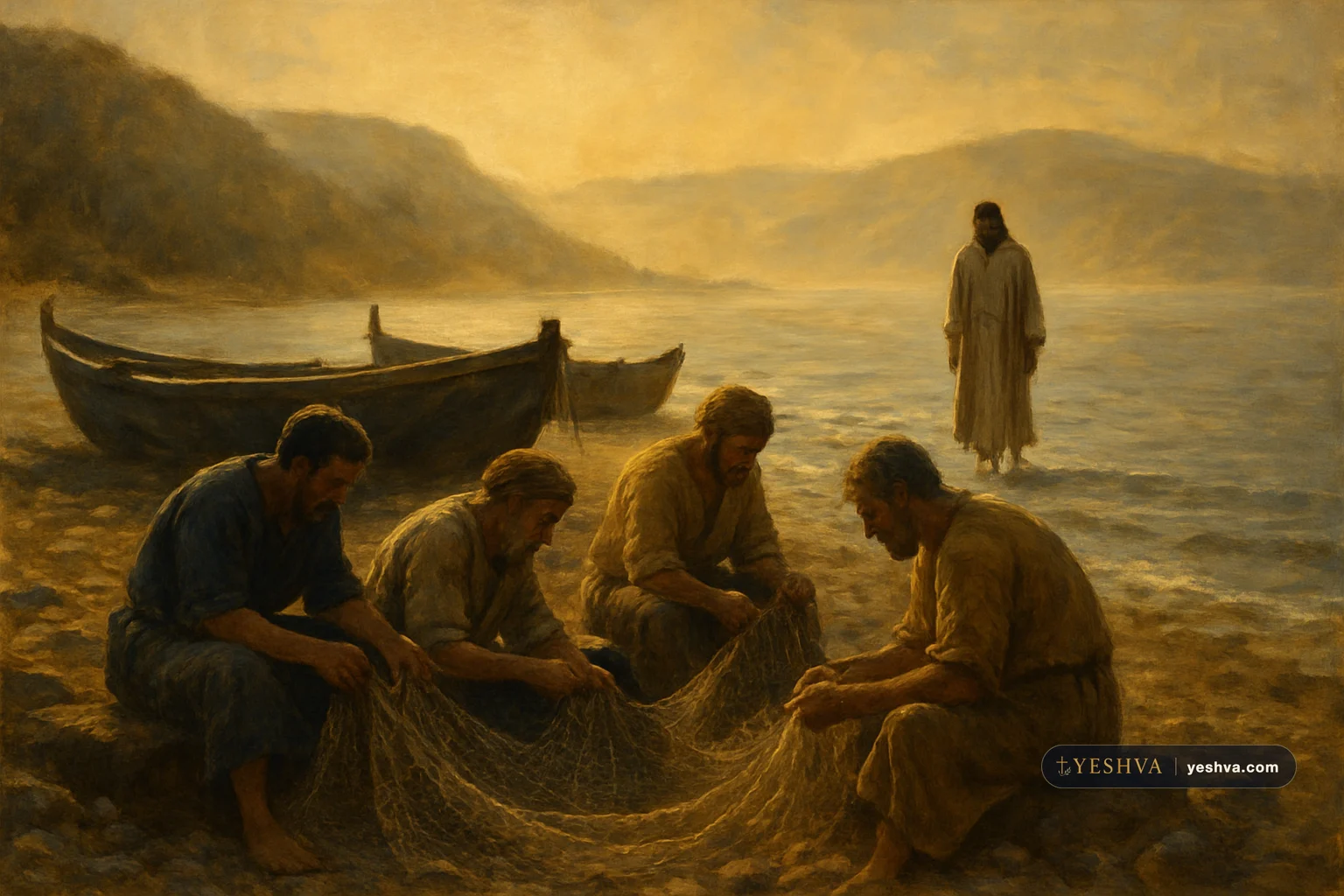
Between the river where Jesus was baptized and the hillsides where he began to teach, the Gospels place a stretch of empty desert. For about forty days Jesus was alone there, hungry, and, the Gospels say, tested by the devil. It is one of the most human scenes in his whole story, and it raises honest questions: Could Jesus really be tempted? Why would God allow it? And what does it have to do with anyone today?
What happened in the desert
Matthew, Mark and Luke all tell the story. Mark gives it in two sentences: the Spirit drove Jesus into the wilderness, where he stayed forty days among wild animals, was tempted by Satan, and was cared for by angels (Mark 1:12). Matthew and Luke slow down and describe three specific temptations (Matthew 4:1, Luke 4:1).
Notice who leads Jesus there. It is not an accident or a detour. The same Spirit who came down on him at the Jordan takes him into the desert. The testing is part of the path, not a break from it.
Three offers
Turn stones into bread. After weeks without food, Jesus is starving. The suggestion is simple: if you are God's Son, use your power to feed yourself. Jesus answers with words from Deuteronomy about people living not on bread alone but on everything that comes from God (Deuteronomy 8:3). He will not use his power to escape the trust his Father has asked of him.
Throw yourself down from the temple. The devil takes him to the highest point of the temple in Jerusalem and even quotes a psalm about angels catching the faithful (Psalms 91:11). Jump, and let God prove himself in front of everyone. Jesus replies that we are not to put God to the test (Deuteronomy 6:16). Trust does not mean forcing God's hand with a spectacle.
Bow down, and the world is yours. Finally the devil shows him the kingdoms of the world and offers them all, for one act of worship. It is a shortcut to the throne without the cross. Jesus refuses: God alone is to be worshiped and served (Deuteronomy 6:13). Luke adds that the devil left him until another opportunity (Luke 4:13), a quiet hint that the testing was not over.
Why these three?
Each temptation pressed on something real. Hunger is a real need. Wanting people to see who you are is understandable. Wanting the world set right is good. The temptation in each case was to get a good thing in the wrong way, apart from trusting and obeying the Father.
The answers Jesus gives are also telling. All three come from Deuteronomy, from the part where Moses reminds Israel of their forty years in the wilderness. There, Israel was tested too: they grumbled for bread, demanded proof that God was with them, and turned to other gods (Exodus 16:2, Deuteronomy 8:2). Many Christians see Jesus walking back into that same story and getting it right. Where Israel stumbled, the Son stays faithful. Some also see an echo of the garden, where the first humans listened to a voice that questioned God's goodness and reached for what was not given (Genesis 3:1). Jesus hears the same kind of voice and does not reach.
Could Jesus really be tempted?
Christians have thought carefully about this. The New Testament says plainly that Jesus was tempted in every way we are, yet without sin (Hebrews 4:15). The temptations were not play-acting. The hunger was real, the pull was real, and the choice was real.
At the same time, Christians believe Jesus never gave in. Some theologians have argued that because he was fully God he could not have sinned; others stress that his humanity was so real that the struggle had genuine weight. Most agree on the main point: being tempted is not the same as sinning. Jesus felt the pull and said no. That is why the letter to the Hebrews says he is able to help those who are tested, because he went through it himself (Hebrews 2:18).
What it means for us
For many people the most comforting part of this story is simply that Jesus has been there. Whatever pressure you face, hunger, loneliness, the wish for a shortcut, the voice that says God is not really good, he knows it from the inside.
The story also shows a way through. Jesus did not win by sheer willpower or a dramatic display. He leaned on what God had already said and on his trust in the Father. Christians are encouraged to do the same: to know Scripture, to pray, as Jesus later taught, not to be led into temptation (Matthew 6:13), and to remember that God provides a way to endure (1 Corinthians 10:13). James adds that temptation never comes from God himself (James 1:13).
And the desert was not the end. Luke says Jesus returned to Galilee in the power of the Spirit and began his public work (Luke 4:14). Testing came again, most of all in the garden the night before the cross, where he prayed that his Father's will be done (Luke 22:42). The faithfulness shown in the wilderness carried all the way to Easter.
If you want to read it yourself, start with Luke 4:1. It takes only a few minutes, and it is a good place to meet Jesus as someone who knows what it costs to say yes to God.